- Myths, Legends and Folktales of Shropshire
- King Arthur: A Shropshire Lad?
King Arthur: A Shropshire Lad?
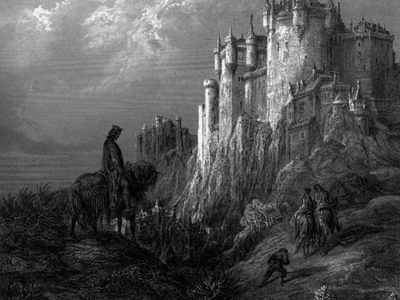
Everyone has a claim on King Arthur.
Cornwall says he was born at Tintagel. Wales says he never really died. Glastonbury spent several centuries insisting he was buried there, which was convenient for tourism. Even the Romans get a look in - some historians believe the legend grew from memories of a real Roman commander holding the line against the barbarians.
But one of the most compelling cases for a historical Arthur comes not from the mists of Avalon, but from the very ordinary-looking Shropshire village of Wroxeter. Five miles from Shrewsbury. Just off the B4380.
*
The theory centres on a fifth-century warrior king named Owain Ddantgwyn. He was a Briton - Welsh-speaking - who led his people against the invading Anglo-Saxon forces sweeping across the country after the Romans withdrew. He was fierce, effective, and apparently rather good at winning battles.
His battle name was Arth - meaning Bear, in the Brythonic language spoken across Britain at the time. A name that, over centuries of retelling, might well have become Arthur.
His father's battle title, meanwhile, was Yrthyr Penddraig - the Terrible Head Dragon. Of course, King Arthur's father, in the famous legend, is Uther Pendragon.
According to Owain's legend, it was his own nephew - a man named Maelgwn - who finally brought him down, at a battle called Camlan. In the legend, King Arthur is killed by his nephew Mordred, at a battle called Camlann.
At some point, the coincidences stop feeling like coincidences and more like roots.
*
And there's more yet!
Owain's seat of power, according to some theories, was Viroconium - the Roman city that stood where Wroxeter stands today. In its heyday, Viroconium was the fourth largest city in Roman Britain, a sprawling metropolis of around five thousand people.
After the Romans left, most cities of its kind were abandoned. Viroconium wasn't.
Archaeological excavations in the 1960s revealed that the city was not only reoccupied in the late fifth century, but extensively rebuilt - sophisticated timber buildings of Roman design, multi-storey, with colonnades and orderly facades. An engraved stone found at the site, dated to around 480 CE, records that the city was occupied by a king of Owain's own family.
The rebuilding matches, almost exactly, the period when King Arthur is said to have been at large.
Of all the major cities of post-Roman Britain, only Viroconium shows clear signs of rebuilding and fortification in the later dark ages - suggesting it may have become the de facto capital of a fragmented, embattled nation. A Camelot in all but name.
And then, around 520 AD - the same year Owain is thought to have died - the city was abandoned. Its people retreated westward into Wales. The great rebuilding project stopped, mid-construction, and was never resumed.
*
The theory has its critics, and nobody is claiming it as fact - this is Arthur we're talking about, after all, a figure who has resisted definitive explanation for fifteen hundred years. But the case for Shropshire is more than a little thrilling.
The ruins of Viroconium are still there, just outside Wroxeter - the largest surviving freestanding Roman ruin in England, standing quietly in open farmland as if waiting for someone to notice.
There's a museum on site, and you can walk among the remains of the bathhouse and basilica where, if the theory holds, the real King Arthur once held court.
Camelot. Five miles from Shrewsbury. Just off the B4380. How about that?

Join our newsletter
Sign up to our Original Shrewsbury newsletter to be first in the know about upcoming events, offers and promotions. We'll also send you handy guides to help you make the most of what our beautiful town has to offer.